In praise of bookends

The best part of the day was not seeing another soul until, on the long trek back to the truck, a couple of game wardens pulled up next to us as we trudged down the two track.

“How’s the fishing?” the driver said as way of formality before asking us for our licenses. I’d hoped he’d sense our fatigue and offer us to clamor in the back of the pick up, but after checking our paperwork he thanked us and drove off with little apparent sympathy.

The day had begun with a lovely rainbow in my net at the very first run I’d fished. It had moved out from under a cut bank to take the dry fly. Startled at such swift response to what was essentially my first serious drift, I set the hook too soon, pulling away the dry fly but succeeding in snagging it with the dropper on the side of its jaw.
 

Being of the school of thought that preaches that anywhere forward of the tail counts, I landed and released it with no qualms beyond the traditional that haunt messing with wild creatures for purposes of amusement. The monkey was off my back before breakfast was half digested. Often, new water will keep its secrets from me til well into the day, occasionally not yielding them at all. Little did I know that the next fish I would touch would be several miles upstream with the sun already dipping below the surrounding peaks.

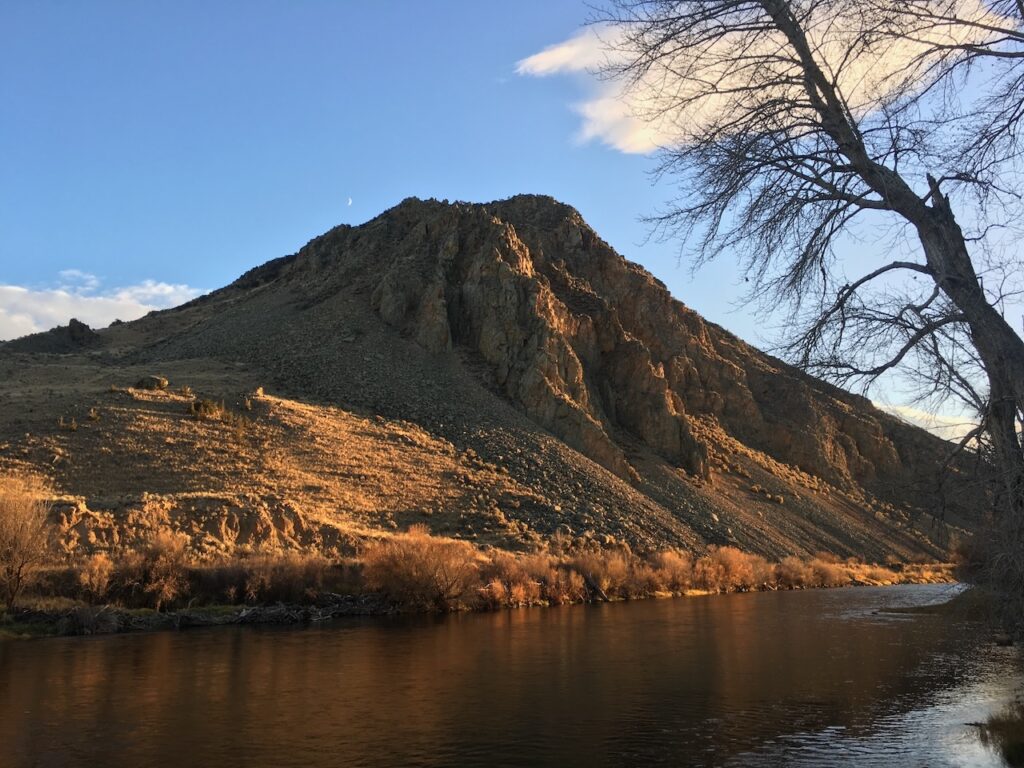
The river flowed north out of the mountains, an apparent anomaly that, combined with arriving at our campsite long after dark, served to unsettle my internal compass. We’d driven for fourteen hours across rolling plains, wind buffeting and surging, leaving its imprint on the tall grasses like waves upon a windswept ocean. Our destination, a distant mountain range, loomed slowly larger yet, by the time we got there, yielded nothing of its detail save its silhouette in the onset of nightfall.

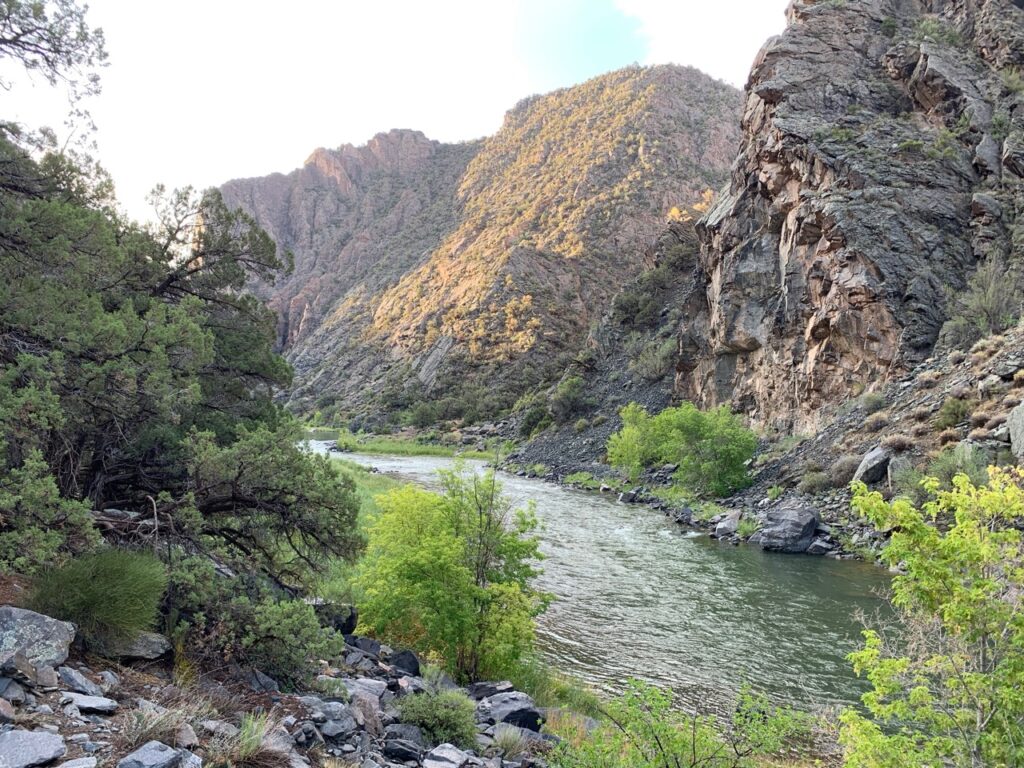
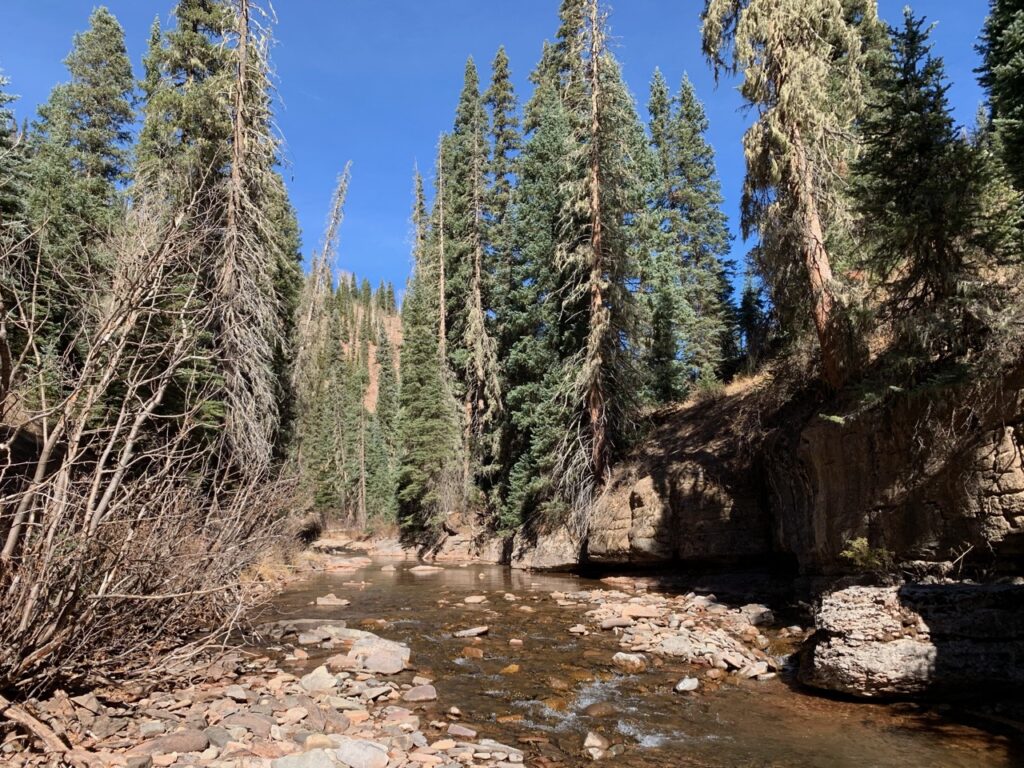
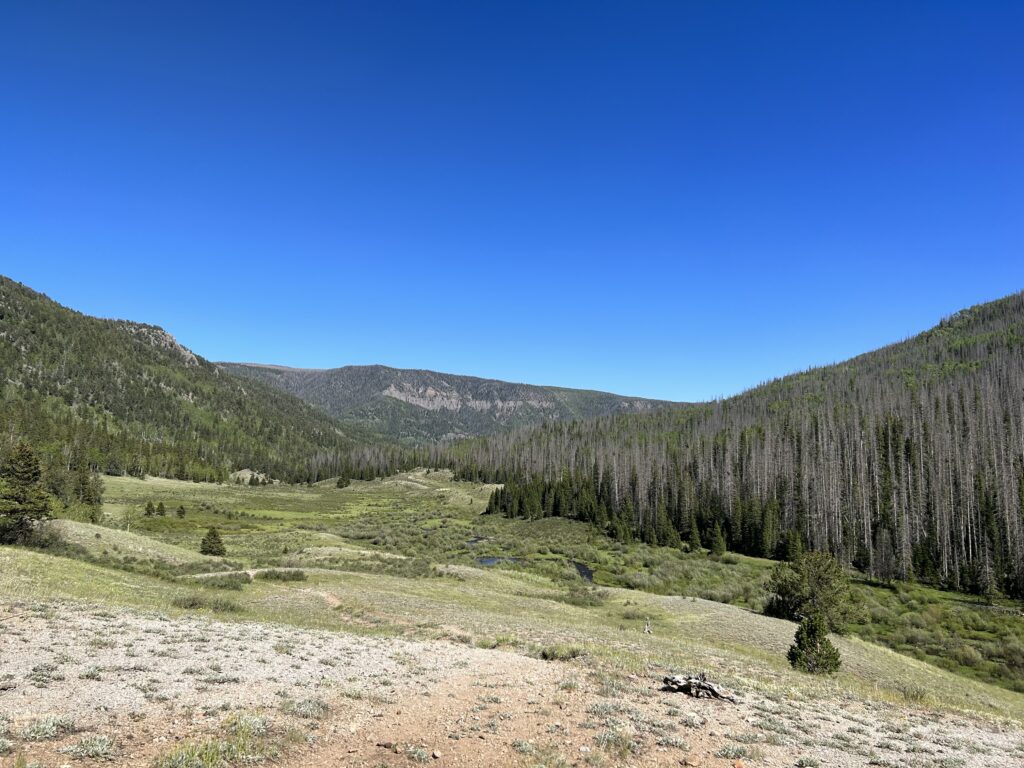
Now, as I made my way upstream in the early morning light, I tried to center myself in these new surroundings. The river flowed at a steady push down a narrow valley, its flanks covered in tall timber with patches of aspen still bare against the otherwise enveloping green. The river’s constant gradient and bouldery bed provided much pocket water but little in the way of long, steady glides.

As usual, Caveman picked up fish steadily while I seemed to select only the barren patches of water to chance. As we sat eating lunch with our backs against a weathered log there came the sound of breaking branches across the river and a bull moose emerged to stand on the opposite bank, drooling heavily and with one half of his antler rack missing. We sat still and quiet as he stood, looking around like he’d just woken from a bender and was trying to figure out whose backyard he’d passed out in. After thirty seconds or so he turned and wandered back from whence he’d came, to our collective relief.

And so toward the end of the day I found myself at the door of a small falls where the river tumbled over boulders in a cascade of white. The falls emptied into an aerated pool with several current seams meandering between a further scattering of boulders. As I stood my boots settled an inch or two into the soft pea-gravel bed, as if drawing me into this place. I cast to one of the current seams and followed the drift until I lost sight of the fly in the glare off the water but something made me leave it to drift a few seconds further then by instinct I raised into a set and felt a fish on the end of the line.

A minute later I cradled a beautiful high mountain cutthroat in the flow then lowered my hand away from its belly and watched as it merged with the depths. I reeled in my line then, still held by the gravel, looked around at my surroundings and wondered for how many aeons cutthroats had lived in this pool below the falls.

I walked downstream to where Caveman was working a pour-over off a gravel bar and made the universal sign for cerveza. He nodded in agreement and we clambered up the bank to the two track and began making our way back to camp.

Share

The Tourist Trap

“Oh yeah dude, they’ll be sipping off the top for sure,” the twenty-something behind the fly shop counter enthused. His buddy nodded.

“Yeah, totally. Sipping for sure.”

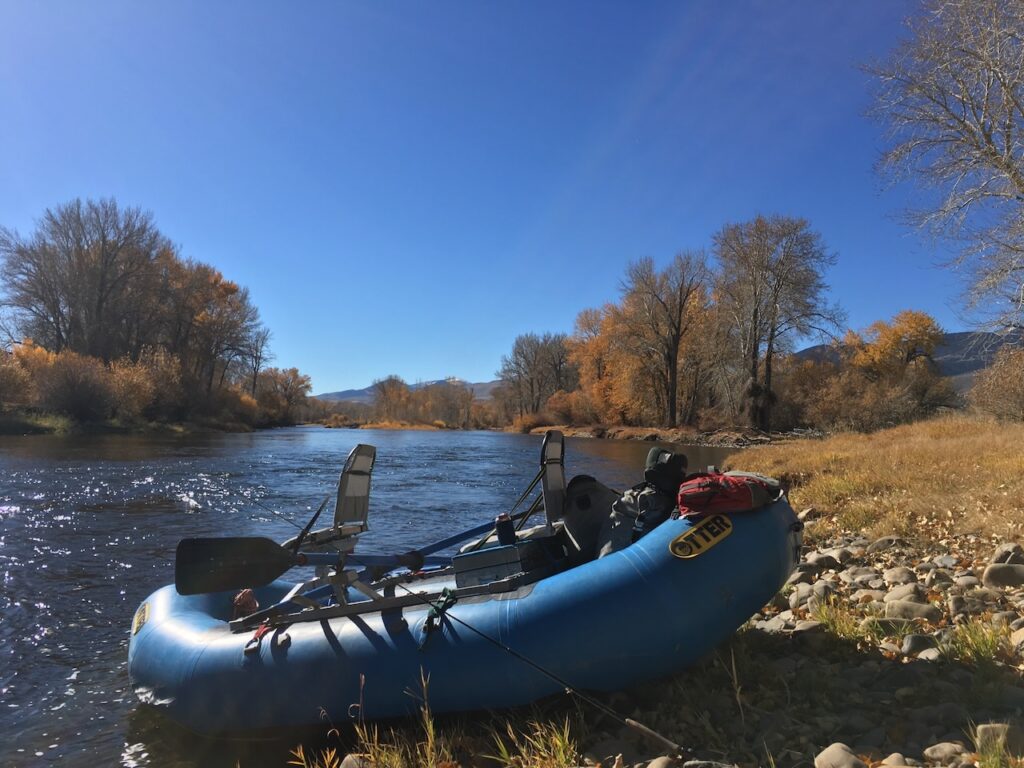
Shuttle arranged and following their directions, we drove the short distance to the boat ramp on the edge of town, the last traces of cool leaving the blue and gold of a Montana morning. Several vehicles were already parked in the lot. Three drift boats sat at anchor against the shore immediately downstream of the ramp, their occupants engaged in last minute rigging and stowing.

“Let’s launch and hang out upstream till these guys clear out,” suggested Cave. Boat launched, we rowed a short distance upstream and dropped anchor, thirty yards below where a concrete bridge spanned the river. It seemed like a good time to open the beer cooler. Already, there were fish rising just below the bridge, and out toward the middle of the river in a barely discernible eddy line coming off one of the bridge supports.
“Give ‘em a go, mate,” Cave suggested.

I eyed the risers warily. Bridge fish tend to be smart fish. Every tourist and his dog has probably thrown a fly at them already this summer. They’ve likely seen every bad drift and poorly presented fly known to humankind. There was likely a reason why the other anglers, all of whom sported local plates on their vehicles, hadn’t bothered with them. On the other hand, what if the young fellas in the fly shop were wrong, and these would be the only risers we’d see all day? Against my better judgement, I took up my rod.

I decided to try for the fish working the eddy line out towards the middle of the river. If I hook one, I reasoned, I’d be able to play it close to the boat and not spook those upstream. I stood and fed out line, guessing the distance between me and the fish and laid down my first cast. A little short. I stripped off another three feet, picked up and cast again, working the extra line out. On my last back cast before laying the line on the water I snagged a tree behind me, high up the bank. Cave sniggered. Thankfully no one else witnessed my amateurishness, but I had to break the fly off and retie.

Confidence rattled, I next turned my attention to the feeders upstream, still rising in two feed lines about four feet apart. With nothing behind me to hinder my line this time, I cast under the bridge to the outer feed line. The fly landed clumsily in a cluster of leader and tippet, drifting down through the feed line unmolested. I waited a couple of minutes, and noticed that since my duff cast, no fish had risen again in the feed line.

“Didn’t like that,” Cave offered helpfully.

I thanked him for his powers of observation, and turned my attention to the inner line, which still showed regular dimples. This time my cast landed delicately about three feet above the main cluster of risers. Perfect. As I squinted into the glare of the morning sun, my fly was only visible when descending the back sides towards the troughs of the small waves. It disappeared from view in the glare. I saw a rise near where I thought my fly should be, and set. I felt a momentary pull on the other end, then nothing. All rising stopped.

My mother had washed my mouth out with soap for language far milder than I unloaded to the heavens. Cave sniggered. Three casts, three screw ups, three different ways.

“Let’s wait a few minutes and see if there’s one fish in the river I haven’t managed to put down.”

I sat and reached for my beer. Across the river the countryside rose in steps, from floodplain to rolling golden hills that merged into fingers of green forest and finally, etched against sky and cloud, peaks of bare rock, grey and pointed. Water lapped gently against the hull of the boat. We finished our beer. The water beneath the bridge remained free of risers. Hauling up the anchor, the tourists floated downstream.

Share

Private Sattler

The remains of Private Jacob Sattler are laid to rest on a bluff just off the two track as it begins its final descent to the bottomland. A small wooden corral marks off his resting place. Inside the corral a mound of stones denote his aspect of rest, facing toward the first light of morning. A simple headstone reads “Jacob Sattler, Pvt, US Army, May 1881”. Two small Stars and Stripes flutter in the breeze at each end of the corral, and a half-dozen plastic flowers, red, white, and blue, sit next to the headstone.

Little is known of Private Sattler beyond what is inscribed on his headstone. A veteran of twenty-five years’ service in the army, he departed Fort Garland in the spring of 1881 to hunt deer, and was never heard from again. His remains were discovered two and a half decades ago alongside the stream that flows at the foot of the bluff. His death is thought to be the result of a self-inflicted gunshot.

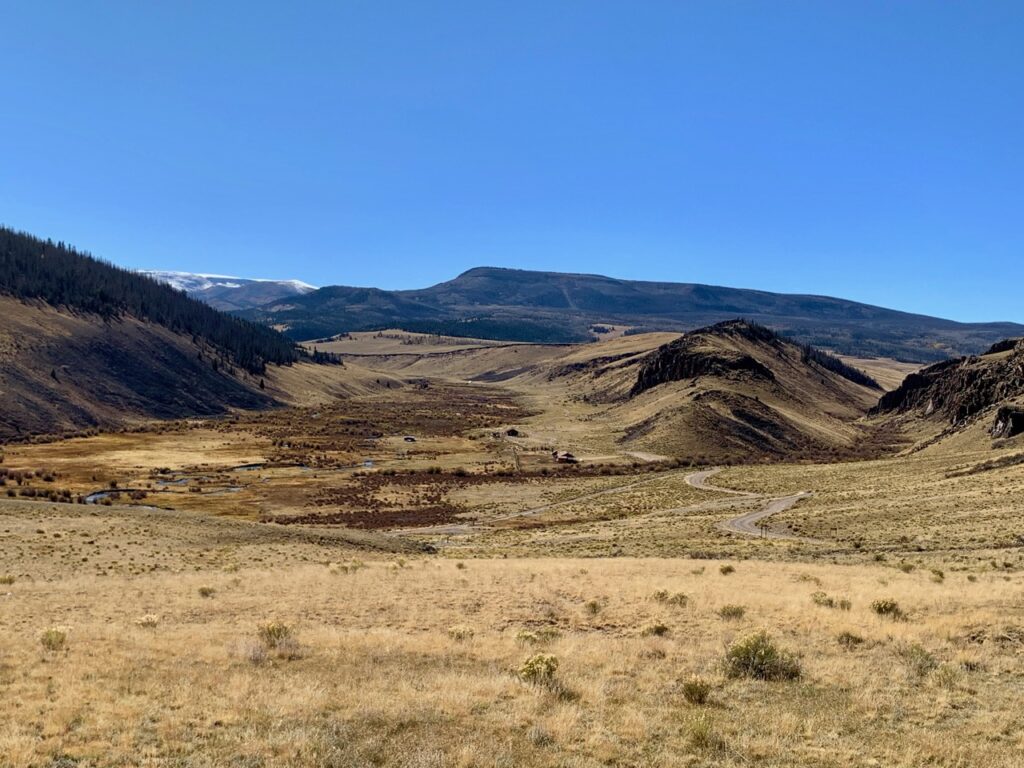
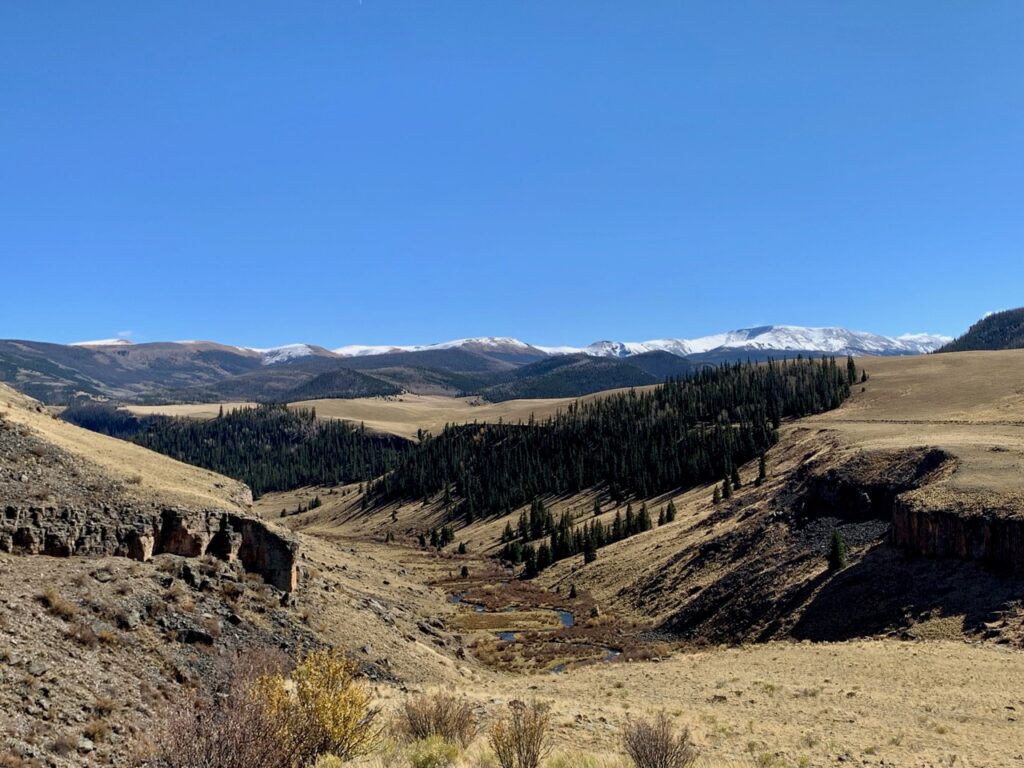
He rests in a place of great beauty. Looking west beyond his headstone, the valley tapers as it curves towards the south. A small stream cuts its course back and forth across the bottomland, in places reflecting snatches of silver from the sun overhead. The ground rises steeply from the valley floor, lifting towards mountains topped with stands of dark timber and in the distance, glimpses of snow dusting the otherwise bare peaks of the San Juans. To the east the stream tumbles through a narrow gorge at the foot of the bluff, disappearing from view then re-emerging where the terrain widens, the slope of the countryside hinting of plains beyond.

Closer inspection reveals the footprints of modern-day intrusion upon the landscape. A couple of dirt roads score the earth’s surface. A small cabin and a cluster of cattle pens sit in the distance, and although I stand alone today, this valley is something of a playground for hunters, anglers, ATVers and hikers. We celebrate the peace and quiet and apparent solitude which provide a break from our busier lives yet once we’ve had enough leaving for our creature comforts involves little more than the turn of a key.

Author and mountaineer Robert Macfarlane posits that mountains, and by extension the natural world, exist contemporaneously in two separate planes, one the fact and sum of their physical reality, the other the values and perceptions we ascribe to them both as individuals and collectively through shared cultural values. To some the relationship to this countryside was looked at through the lens of partnership, the land viewed as a nurturer and provider. To others the lens was one of confrontation, the land a place of danger and wildness to be conquered, moulded, and exploited.

Twenty five years of service that included the Civil War and the conquest of a frontier that while wide open and beautiful, but equally solitary, harsh, and indifferent, able to turn violent and visceral in the blink of an eye. For some, once the threshold was crossed, there could be no going back to life as it was before, no unseeing of what had been seen, no staunching of what had been cut open.

I wondered of Private Sattler’s relationship to these lands, and the valley in which he elected to die.. Who knew what his eyes would have witnessed over those twenty-five years of service. Sanity and survival would likely have depended on equal parts luck and smarts, and if either ran out……

I hop back in my truck, continue down the road and establish my camp next to the creek. That night, coyotes howl in the far off under a sky immense, cold, and silent, the same sky that Private Sattler would once have gazed upon, a sky as capable of engendering as much a sense of dread as awe, of anger as acceptance, of despair as succor.

Share

After The Flood

Despite the overnight dousing, next morning the river still ran clear. We breakfasted, broke camp and I volunteered to row while the others fished, the morning cool, the canyon still in shadow. Churning whitewater interspersed languid banks overhung with tall grasses dipping into the current, where a patient drift would sometimes yield a fish rising to a dry fly.

“The tail-out of this next rapid is a great one to nymph,” said Mort. “Pull over below. You should fish it.

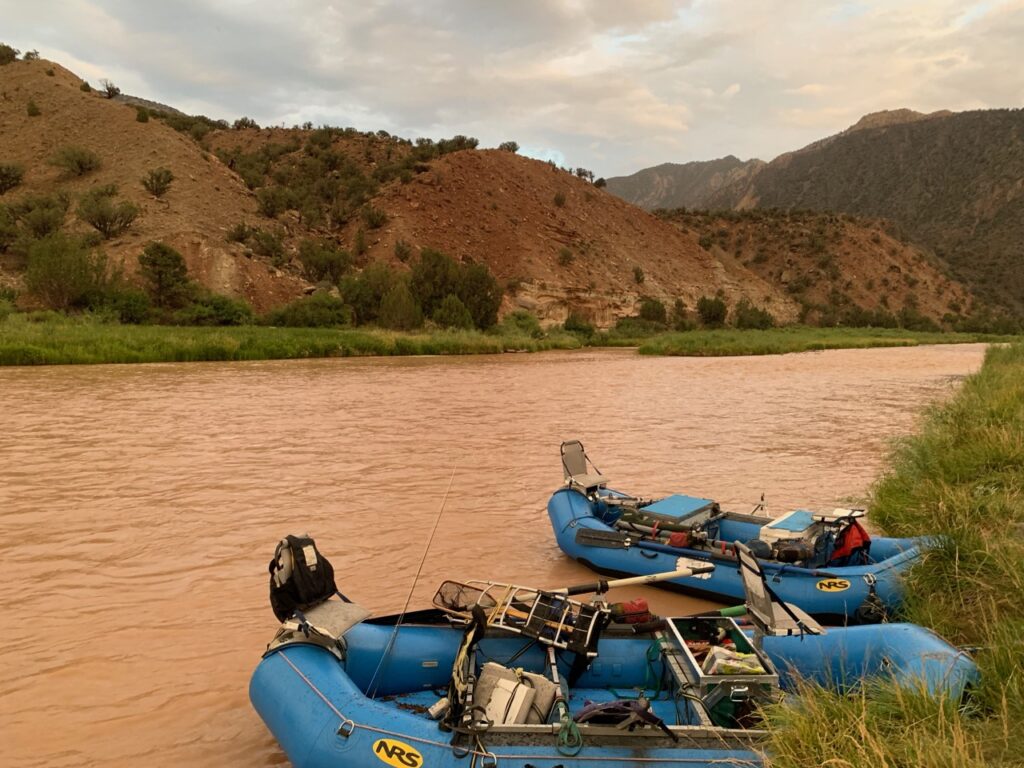
I eased the raft onto a narrow strip of sand backed up against a cliff face that angled out towards the river. While the others sat on the sand and opened beer, I rigged a rod for nymphing then walked upstream toward the run. A broad fan of whitewater narrowed toward the far bank, creating a trench with several distinct seams of current, slower and more shallow in close, faster and deeper further out.

I started first with lighter weight, adding more as I worked into the faster water. I quickly became absorbed in my task, my sole focus the indicator and mending the line to prevent it being dragged by the several current seams of differing speed and direction. Several times I set the hook to what I imagined a strike, only to pull up flies encased in river weed.

Beyond where I felt safe wading a large flat boulder sat subsurface. Had the river been lower, it would have provided an ideal platform on which to wade out to in order to access the deeper, faster seams toward the far bank where the larger fish no doubt lurked. Instead I targeted multiple drifts around the boulder and twice hooked into fish that darted deep then leaped, thrashing and silvery in the daylight, and twice slipped the hook.

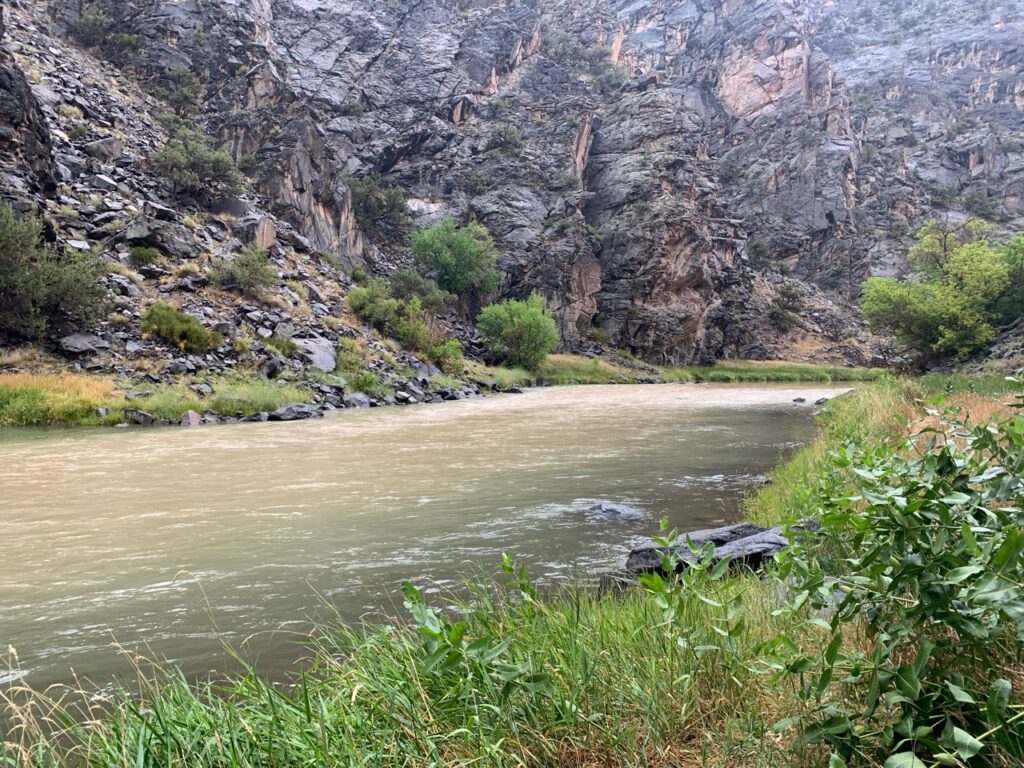
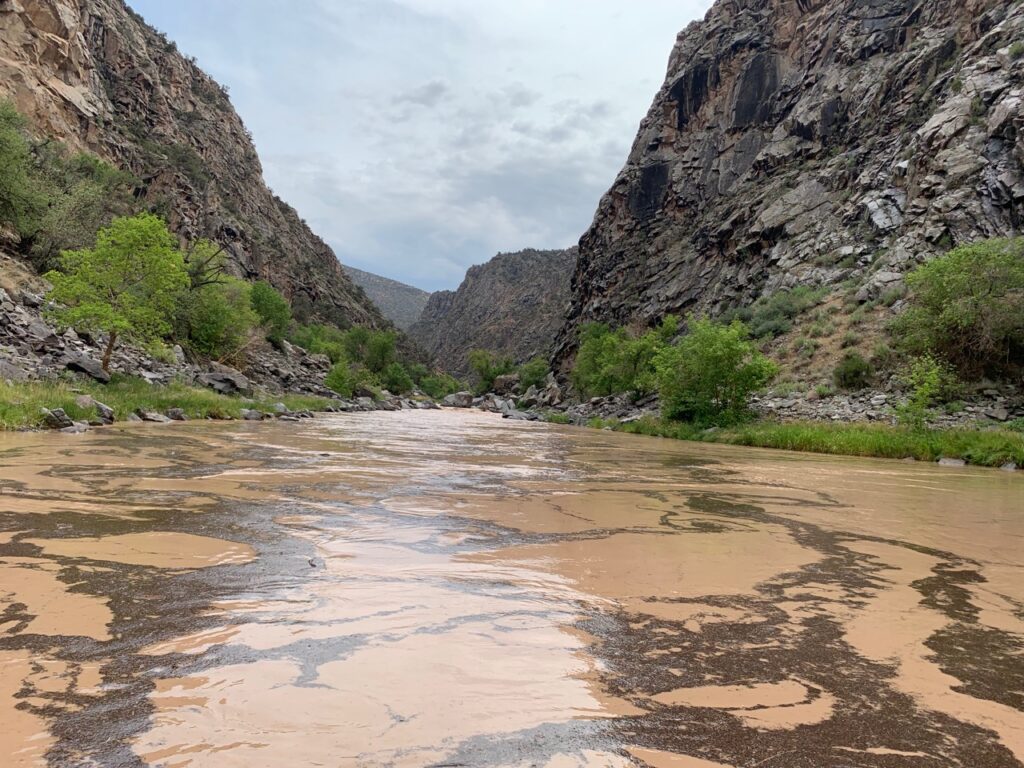
So entranced by the river and its nuances, I hadn’t noticed the dark clouds rolling in until a rumble of thunder caused me to look skyward. Soon a light rain began to fall and I retreated to the beach where, in the lee of the overhanging cliff face a lunch table had been set up. I built a hearty sandwich then stood and ate as curtains of rain played swirling patterns upon the river’s surface. After half an hour the rain eased but then a change came over the water, at first turning a chalky green before tea-colored then chocolate milk with heavy slicks of debris – pine needles and cones, juniper berries, sticks and twigs and anything washed down out of side canyons upstream that had borne the brunt of the cloud burst.

From the river, now thick and turbid, rose the scent of mud and juniper. Small trees bobbed in the current and the beach on which we stood began to shrink as the water level rose.

“Must have hit hard in one of the side canyons,” someone opined. “We only caught the edge of it, I guess.”

“Well, that’s fishing done for today,” I observed, and began the process of breaking down my rod. I reached into the drag bag tethered to the raft and withdrew a beer, blowing the muddy water from the rim of the can before opening it. Creation at work, I thought, as I looked out across the river to the cliffs of the far bank where slender waterfalls had begun tracing familiar paths stained with the watermarks of previous downpours dating back who knew how far.

We reached camp early, pitched tents then lined our chairs along the river bank and watched the desert flow by.

Share

November in the High Country

Following a fifteen degree night in a twenty degree sleeping bag, I wake to a frozen five- gallon water jug, and the realization that I may have chosen the coldest place to camp in the entire valley. Kicking the jug frees up enough water to brew a cup of tea, then, like my dog on the living room rug on a winter’s day, I position myself in anticipation of where the sun will first reach.

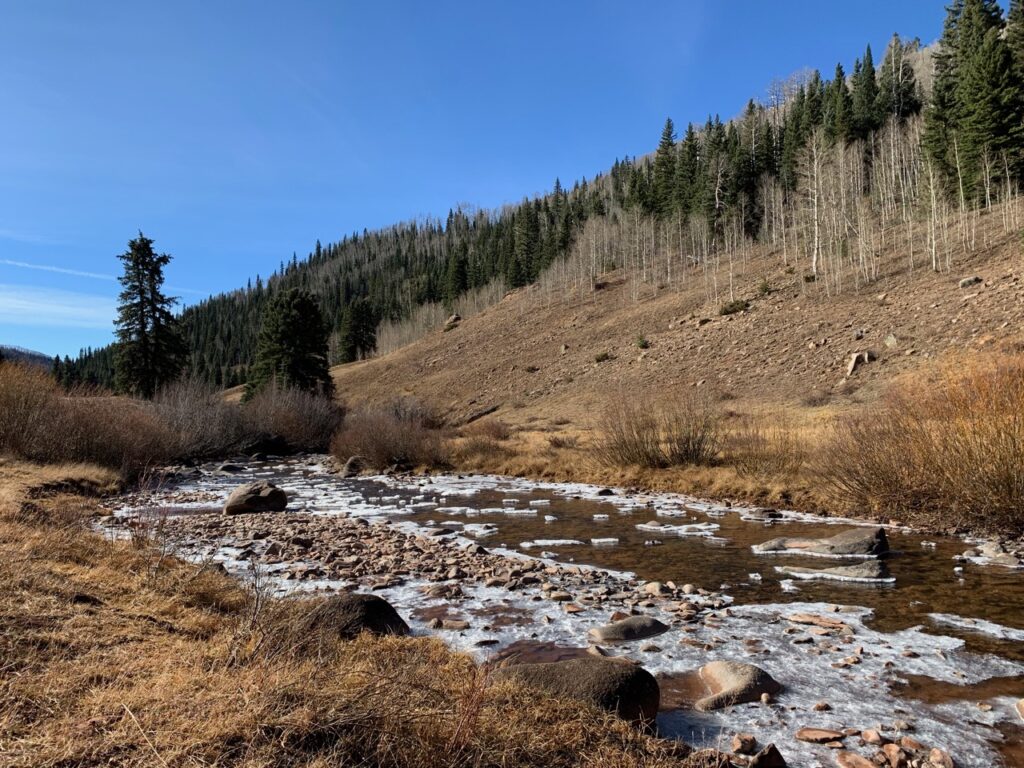
After breakfast I take to the trail downstream. The creek bears all the hallmarks of a low water year—sparse save for the occasional deeper pool, a layer of reddish silt covers the bed, swept clean only where seams of current are concentrated. The water flows gin-clear, and I stop from time to time as I hike to spot fish, for reassurance. They seem few and far between, but seeing even one or two gives me hope that my day may be fruitful. Thin ice shelves have formed overnight, and the fish I do see hold station beneath these, watching the open water. My hope is that, as the sun rises higher and the day warms, the ice will disappear.

The canyon narrows the further down I hike, and trees grow heavy to the water’s edge. Although the trail shows ample sign of having been well used—ATV and bike tracks, boot and hoof prints—I encounter nobody. From the south a small stream, little more than a trickle, is frozen in place, the boulders over which it flows cased in ice. Many places down here will not see direct sunlight for the next several months.

I come upon a clearing where a small meadow opens out, and the transition from dark to bright, the reflection of light off one boulder in particular, brings with it the onset of a migraine. The angry amoeba behind my eyeballs grows bigger and brighter and more jagged, morphing its shape and color. I lie down next to the stream. Using my pack as a pillow, I slip into a half doze as the amoeba does its thing. Van Gogh drove himself crazy, not to mention half blind, trying to paint the sun, and I wonder at the effect on my state of mind if I made it my life’s mission to try and accurately paint in words the sound and soothing of gently running water.

The worst of the headache passes, and I begin to fish my way back upstream. I catch a couple of lovely brook trout, including one large for the stream, with a gaping mouth colored black on the inside of its jaws. I work one pool for a good half hour, trying to tempt a couple of sighted fish with a variety of flies. The closest I come is when one half-heartedly follows a hopper for a few feet, then turns back to its station. I wave the white flag after losing two flies into the same overhanging branch in consecutive casts.

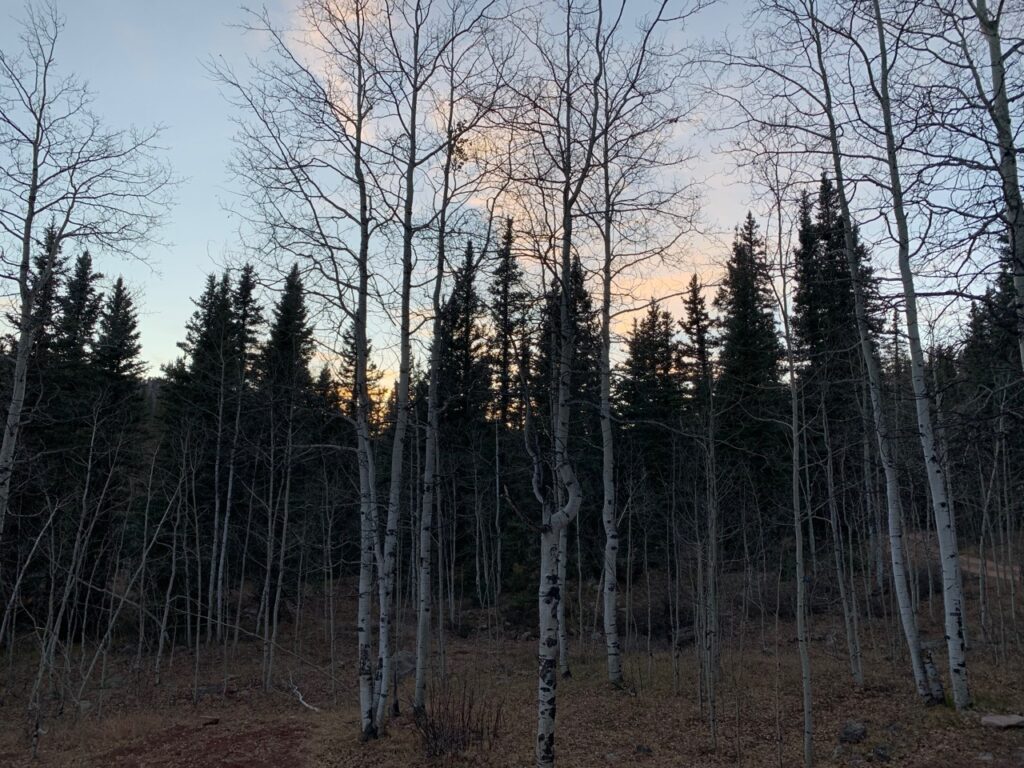
Upon my return, I decide to relocate camp to higher ground, further from the sound of the creek, but to a place where I calculate the sun will reach me earlier, and linger longer. The effort is worth it, my fly rod miraculously survives being shut in the tailgate of my truck, and I sit in the last of the day’s light among the watchful eyes of a small glade of aspens, long since stripped bare for the coming winter.

Whiskey warms me, and I reflect that November might mean cold nights and frozen water jugs, but it also means deserted campsites, and solitary streams.

Share