The Bother of Fish

“We’re going after big fish this afternoon. Enough of this little fish nonsense.”

I reached under the seat for my fly box, rummaging through the collection of parachutes and hair wings with feigned indecision despite knowing exactly what I was looking for.

“I’ve only got one of these, so don’t mess up.”
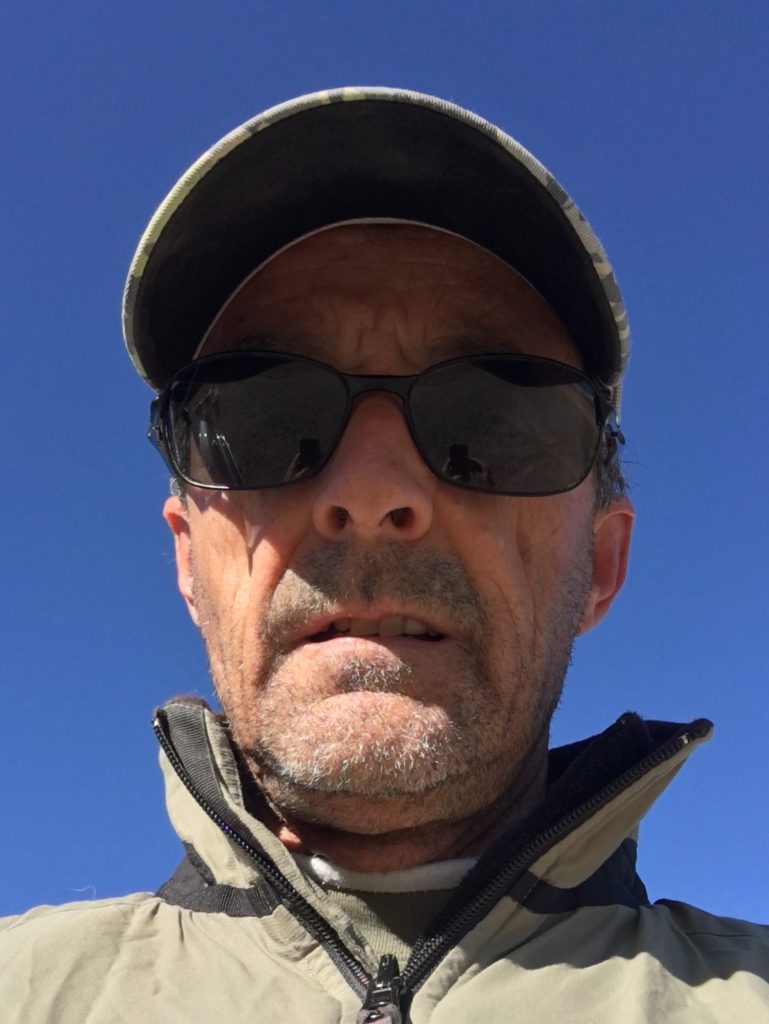
Would you take orders from this man?

I kept my focus on the fly box, knowing eye contact with Andy would cause me to lose the hard-ass facade I was having fun with. I liked Andy. I could tell he’d been nervous at the fly shop that morning, but unlike many anglers who say they want to learn then proceed to ignore any advice you give, he’d tried to incorporate much of what I’d suggested into his technique. I’d told him at lunch he was a lot better angler than he gave himself credit for.

“You’ve got ten casts to show me you can fish this, otherwise I’m taking it back.”

I wondered what his PA or sales team would say if they saw him being ordered around by some guy with a sweat-stained ball cap and five days growth on his chin. I cinched the knot tight and handed him the line.

“I want to see the fly an inch off the bank. I don’t care if you think the water is too shallow, or there’s no fish there, one inch, OK?”

He nodded and began to false cast as I eased the boat out into the current. His first attempt landed a foot out. I waited to see if he would pick up and recast, but he instead shaped to mend.

“Pick it up. You’re a foot shy. You can see the fly, right?”

He nodded and cast again. Eight inches.

“You’re getting closer, but imagine how many fish you’d catch if you cast to where they actually are. Get it in there.”

The next cast hit a rock bank-side and slid into the water.

“Now you’re talking. Keep mending to maintain the drift going as long as you can.”

There was change in the contrast of the water around the fly, a flicker of light in the cobbles, and the fly vanished without any disturbance to the surface.

“Pick it up! Pick it up!”

Half turning, he lifted the rod uncertainly. Following brief tension on the line the fish spat the hook, thrashing momentarily on the surface as it did so.

“Damn. I never would have guessed that was a fish. I didn’t see a thing.”

“Big fish don’t expend an ounce more energy than is necessary. Half the time you set by instinct. Next time, if you sense anything strange—anything—going on around the fly, set the hook. Wait long enough to think about it, it’s too late.”

Three casts later, and the fly nestled against the bank once more. This time the take was a little more obvious, the fish rising and drifting tail-first downstream with the fly before gently sipping it. The hook-up was announced by a huge churning on the surface, showering the rocks and bushes nearby with spray. A couple of minutes later we had the fish in the net, a sixteen-inch brown trout—very respectable for the river and the biggest he’d ever caught. Unhooking it, I lowered the net back into the water and the brown swam free.

Back at the side of the river, I parked the boat and reached into the cooler. One can of beer later, and he was still smiling.

“So, would you rather catch one like that, or half a dozen little ones out in the middle of the river?”

He nodded. I finished my beer.

“Personally, I don’t want my enjoyment of the day to be compromised by messing with too many fish.”

Share

The Bother of Fish.

“We’re going after big fish this afternoon. Enough of this little fish nonsense.”

I reached under the seat for my fly box, rummaging through the collection of parachutes and hair wings with feigned indecision despite knowing exactly what I was looking for.

“I’ve only got one of these, so don’t mess up.”

Would you take orders from this man?

I kept my focus on the fly box, knowing eye contact with Andy would cause me to lose the hard-ass facade I was having fun with. I liked Andy. I could tell he’d been nervous at the fly shop that morning, but unlike many anglers who say they want to learn then proceed to ignore any advice you give, he’d tried to incorporate much of what I’d suggested into his technique. I’d told him at lunch he was a lot better angler than he gave himself credit for.

“You’ve got ten casts to show me you can fish this, otherwise I’m taking it back.”

I wondered what his PA or sales team would say if they saw him being ordered around by some guy with a sweat-stained ball cap and five days growth on his chin. I cinched the knot tight and handed him the line.

“I want to see the fly an inch off the bank. I don’t care if you think the water is too shallow, or there’s no fish there, one inch, OK?”

He nodded and began to false cast as I eased the boat out into the current. His first attempt landed a foot out. I waited to see if he would pick up and recast, but he instead shaped to mend.

“Pick it up. You’re a foot shy. You can see the fly, right?”

He nodded and cast again. Eight inches.

“You’re getting closer, but imagine how many fish you’d catch if you cast to where they actually are. Get it in there.”

The next cast hit a rock bank-side and slid into the water.

“Now you’re talking. Keep mending to maintain the drift going as long as you can.”

There was change in the contrast of the water around the fly, a flicker of light in the cobbles, and the fly vanished without any disturbance to the surface.

“Pick it up! Pick it up!”

Half turning, he lifted the rod uncertainly. Following brief tension on the line the fish spat the hook, thrashing momentarily on the surface as it did so.

“Damn. I never would have guessed that was a fish. I didn’t see a thing.”

“Big fish don’t expend an ounce more energy than is necessary. Half the time you set by instinct. Next time, if you sense anything strange—anything—going on around the fly, set the hook. Wait long enough to think about it, it’s too late.”

Three casts later, and the fly nestled against the bank once more. This time the take was a little more obvious, the fish rising and drifting tail-first downstream with the fly before gently sipping it. The hook-up was announced by a huge churning on the surface, showering the rocks and bushes nearby with spray. A couple of minutes later we had the fish in the net, a sixteen-inch brown trout—very respectable for the river and the biggest he’d ever caught. Unhooking it, I lowered the net back into the water and the brown swam free.

Back at the side of the river, I parked the boat and reached into the cooler. One can of beer later, and he was still smiling.

“So, would you rather catch one like that, or half a dozen little ones out in the middle of the river?”

He nodded. I finished my beer.

“Personally, I don’t want my enjoyment of the day to be compromised by messing with too many fish.”
Share

Once Upon a Time on the Mohaka

My boots settled into the soft pea-gravel of the river bed. I stood silently, thighs and calves braced against the steady press of the river, imagining the soles of my feet growing roots, tapping deeper into the earth beneath me, grounding me to this place and time. I’d last stood in the Mohaka several years ago, and with the direction life was taking, who knew how many more until I did so again?


With eyes closed, I inhaled the scents of the river, cool and humid – beech forest and dank vegetation overlaid with a faint hint of sulphur mingled with heather in bloom. Somewhere behind me a pair of native tui, birds whose white throat-ruff saw Europeans call them Parson’s bird, cackled noisily in the bushes along the river.

The roots grew deeper, through the soft earth and clay and volcanic substrate to the bedrock beneath. Then Steve’s voice snapped me from my reverie.

“Oi, Sunshine! Are you gonna cast to the fish, or wait till it stops feeding?”

I returned my attention to the task at hand. Thirty yards upstream, a small rocky point jutted out into the flow as the river made a sweeping curve to my left. The point created a large back eddy, at the bottom of which I stood. A current seam swirled off the tip of the point, and in this seam a brown trout fed freely, rising every thirty seconds or so to take small mayflies from the surface. Steve, a friend who guides anglers and hunters in this part of New Zealand, had concealed himself in the bushes along the bank above where the fish fed, acting as my spotter.

“OK, false cast directly upstream in front of you. When you’ve got enough line out, I’ll let you know. Then drop the fly in front of the fish.”

I stripped line off the reel then began false casting, once letting the line land on the water ahead of me, well away from the fish.

“Quit fishing like an **#!%$ American!” he yelled, stifling a curse under his breath. “Keep the line off the water!”

He was right. Any hint that there was an intruder present would see the fish disappear into the river’s depths. Suitably chastised, I continued to false cast until he gave the word, and I set the fly on the water, directly on the current seam. It was a small fly, riding low on water reflecting the glare of the surrounding bush.

My first cast was short. A rise, well away from my drift. Second cast, this time in the zone. Another rise. I waited a second then struck hard. The fish, hooked, immediately charged for the faster current in the center of the river while I endeavored to raise the rod tip high, to get some leverage against its pull. Still underwater, it turned upstream then leapt clear of the river, slapping down on its flank as it shook from side to side. The line went slack. Up in the bushes, Steve groaned, head in hands.

“Mate, that was a spanking! Welcome home.”

I shook my head as I reeled in my line. The hook was bent out, straightened to a right angle.

“Well, so much for that.” I gently eased first one, then the other, boot from the pea-gravel and turned toward the shore. The tui still cackled, and in response to the gathering heat of the day cicadas had started to rasp, their collective crescendo rising and falling, an aural manifestation of the river’s pulse, of the life force that flows through and around us.

Share

Solitude on the Bighorn

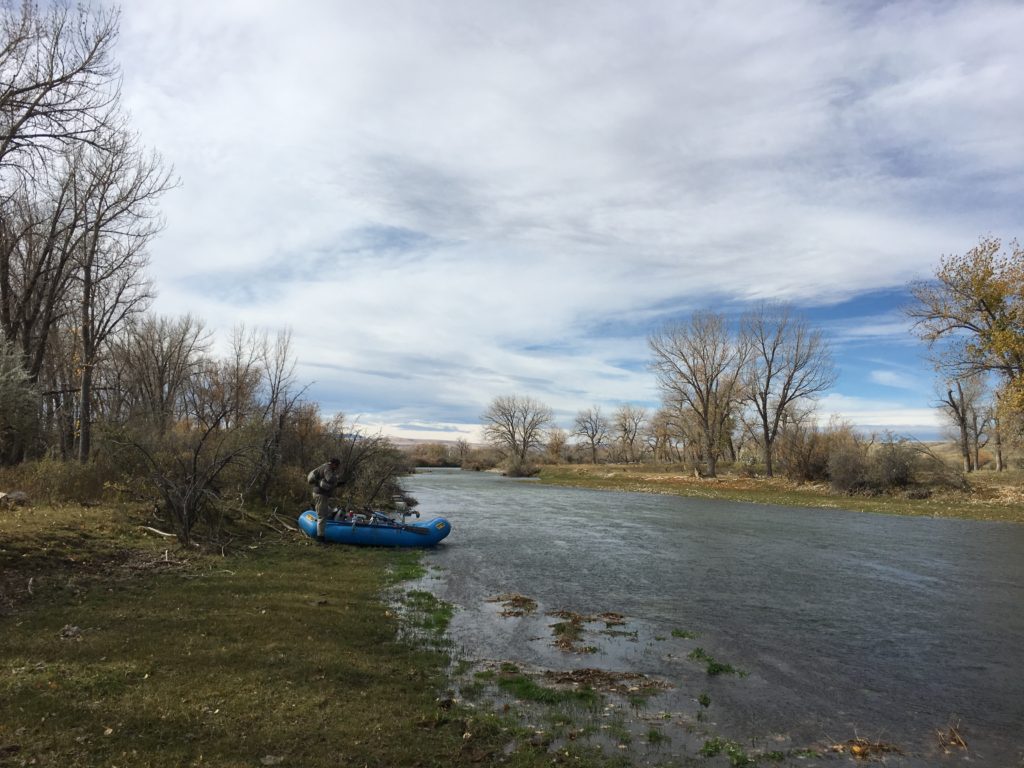
There came, for a brief time in the afternoon, an impression of being completely alone on the Bighorn. Beneath a breaking sky, just the two of us, and the grey vein of the river, pushing northward toward the horizon. Upstream and down, not another boat or person in sight, a rare occurrence on a river this renowned to anglers.

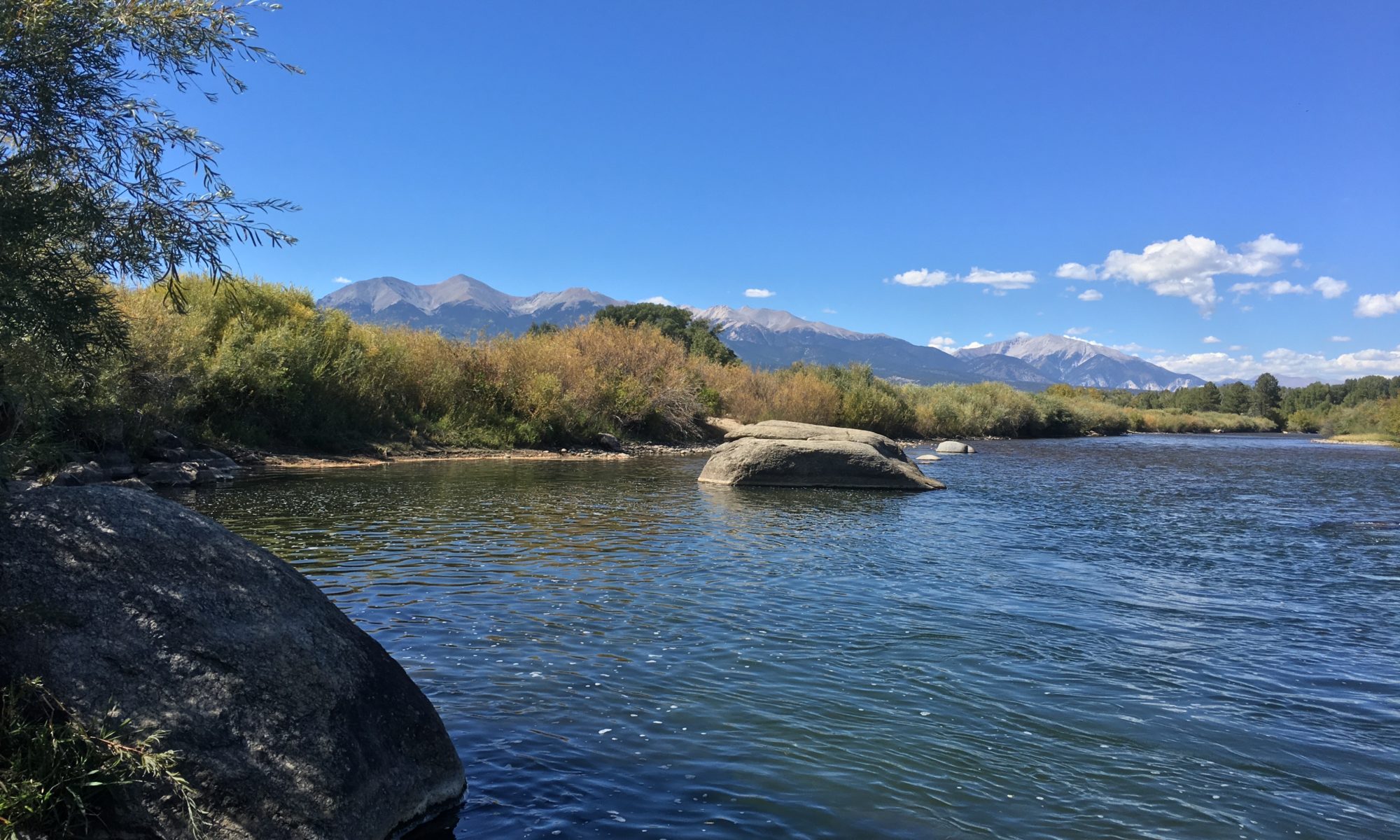
Picture Channel, Bighorn River

Constant wind coursed downstream, leaving its choppy imprint on the river’s surface. Upstream a few miles from us, the lake above Yellowtail Dam was turning over as surface water temperatures cooled, leading to discolored water issuing from the bottom of the dam. Perhaps this combination of elements and natural phenomena helped explain the lack of other anglers that day. Whatever the reason, the solitude adds to the memory.

Below Yellowtail Dam, the Bighorn exits its eponymous mountain range and continues its course across the open plains of southeast Montana toward its confluence with the Yellowstone. Some say this countryside lacks the elemental beauty through which other Montana rivers flow.

This is Crow Indian country, and it was near here that Custer met his demise. The events of that day, and its consequences, are yet tangible, a presence that hangs in the air. At the last it must certainly have seemed to Custer and his men a remote, inhospitable place, as distant from civilization and comfort as the moon, but to my eye the river’s steady course through cottonwood-studded plains, alive with the calls of ospreys and ringneck pheasants, is one of still wild and largely uncompromised beauty.

I pinched a third split shot onto my leader to help the nymphs sink more rapidly to the bottom of the river, and cast again into the wind. Letting the line drift below me and straighten in the current, I used the tension of the water tugging at the line to load the rod and flicked the rig upstream. In this way I worked my way steadily up the side channel – tension cast, mend, let it drift downstream, tension cast again, settling in to a metronomic contemplation of the current seams, riverbed topography and indicator, pausing only occasionally to wait out an extra-strong burst of wind. After fifteen minutes the indicator dove, and I set into a lovely brown trout that stripped line from the reel, heading downstream, me in hot pursuit.

After releasing the fish, I sat on the bank amongst a cluster of small Russian olives, situated too close to the river’s edge to have survived the record high water of earlier in the year. Stripped of their color and foliage, their skeletal remains were plastered with detritus from the river – dried-out weeds, moss, mud and grasses – hanging off them in such fashion they resembled the tattered masts and rigging of some strange fleet of ghost ships, sails torn in disarray.

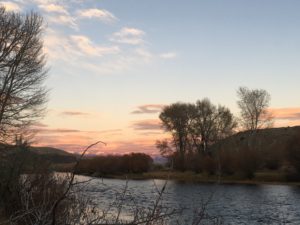
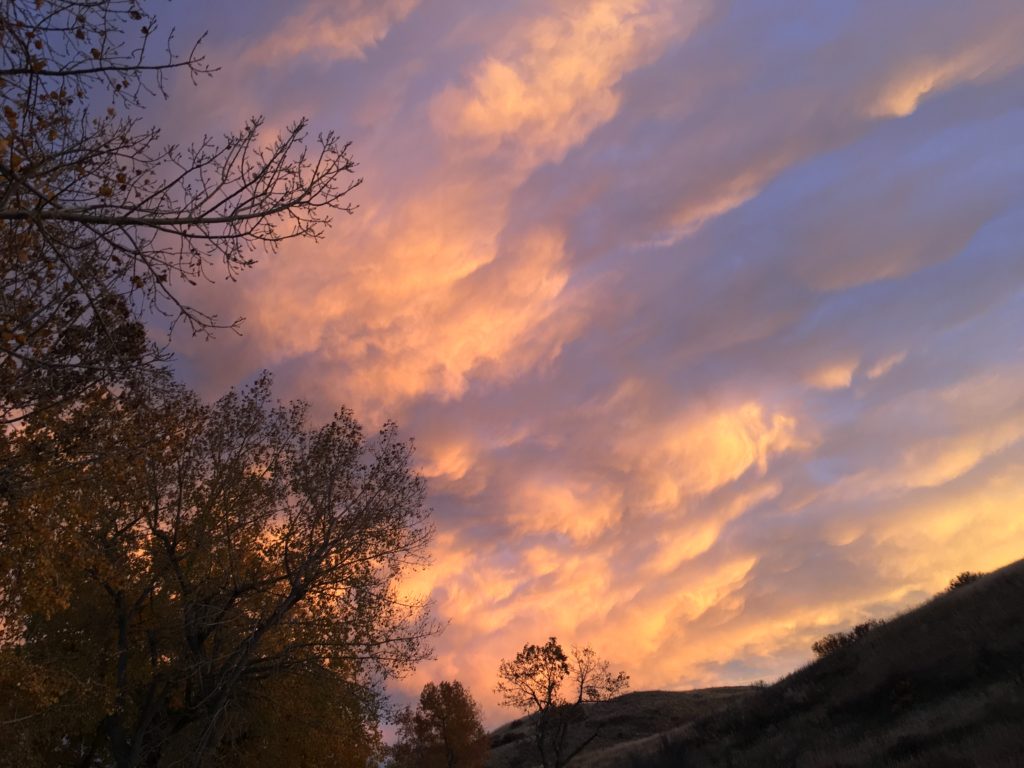
Montana sunset

We floated into a deserted take out early evening, as the low sun found a sliver between earth and overcast to draw forth from the landscape a rich golden hue. Faded cottonwood leaves rattled drily in the dying breeze, the clouds above a swirl of orange and purple. We loaded the boat onto the truck then sat by the river, sipping beer while the sun dipped beyond the horizon, and the lingering twilight that is part of this corner of Montana began.

Share

Struggle and Survival on the Big Hole

Even from a distance of one hundred and fifty yards, it was evident the bird was large. Off on a shallow side channel away from the main flow, it appeared to be struggling with something unwieldy, lying half-concealed in the water. Several times the bird attempted to lift off, grasping whatever it was between its talons, with no success. From the far bank, concealed by a stand of cottonwoods along the river, came the cry of a second bird.
“That sounds like a bald eagle,” said Caveman. “The one downriver looks like a golden.”

October sunset on the Big Hole River, Montana.

We floated closer, silently hoping to get a better view of what it was the golden was struggling with. Upon our approach, the bird lifted off the water in a flurry of enormous wings, retreating to the outstretched limb of a bare cottonwood, where it alighted next to a second golden, stark against a flawless Montana sky.

From upstream came another cry, and we looked to see a bald eagle perched on the branch of another cottonwood fifty yards distant, facing the two goldens. More trash talking ensued between the two adversaries, squaring off like a couple of Wild West gunslingers at the opposite ends of Main Street, high noon.

The stand off continued for another thirty seconds before the bald, followed a second later by the golden, swooped down off their respective branches, the distance between them closing in a matter of seconds. It seemed the extra time the bald eagle had to prepare gave it the advantage of height and position in the initial contact. Suddenly, all was a whirl of extended talons, contorting bodies and flapping wings as they engaged in aerial combat. As quickly as it began, they disengaged, the golden swooping low then turning and retreating to its branch while the bald uttered a cry of apparent victory and flew off toward the spoils of war. A lone magpie, having taken advantage of the larger birds’ distraction, and pecking at whatever it was in the water, beat a hasty retreat as the bald settled on its prize.

“Do you want eddy out and go see what it was they were fighting over?”

I shook my head. “No, let them be.”

For the rest of the afternoon, as we cast dry flies to grassy banks and languid bubble lines, drifting toward a take out where my truck awaited with coolers of food and beer and warm sleeping bags, I thought of the struggle for survival we had just been privileged to witness, one of thousands of such dramas playing out daily in the natural world around us, and of the ties that bind us all, wings, fins, two legs or four.

Share